Friday, March 29, 2013

Latest update from the national stranding network


It was approaching 9 pm, and we were still in the meeting room in Bogor

Being a developing country with one of the longest coastlines in the world, myriad human activities and about 35 species of cetaceans and one species of sirenian, Indonesia is a country with high risk of stranding events. Data from www.whalestrandingindonesia.com showed 102 stranding events since 2000-2012; about half of them were unidentified species. Considering Indonesia’s coastline length (over 80,000 km) this number is more likely to be an underestimation than an overestimation. However, until late 2012, Indonesia had no national stranding committee or any action plans to mitigate, reduce or manage stranding events. The stranding of 48 short-finned pilot whales (Globicephala macrorhynchus) in East Nusa Tenggara Province was a wake-up call for the government to work on the overdue stranding protocol and network. In November 2012, the Ministry of Marine and Fisheries Affairs officially formed a national committee to compose the national stranding protocol and establish the national stranding network. 

On Thursday, 21 March 2013 (after 1.5 days of long meeting in Bogor, hauled till past 9pm...), the national committee has finished the last stranding protocol meeting which produced the final draft of the protocol. The protocol will be published in April 2013 and will be distributed to all provinces in the country. At the same meeting, the committee also discussed the organizational structure of the national stranding network. The national structure will have five sections: 1) data and information; 2) science; 3) live-rescue; 4) post-mortem investigation; and 5) policy recommendations. The live-rescue section will coordinate local stranding networks around the Archipelago. 

Thursday, March 14, 2013

The 3rd Southeast Asian Marine Mammal Symposium (and the importance of having a group to call your own)


Participants of the 3rd SEAMAM symposium in Langkawi (pic by Suwat Jutapruet)


I’m a cetologist, and I’m proud of what I’m doing for a living. However, I do have to say that getting funding for mainly marine mammal works is not always straightforward. Nowadays, I still have to do other works (still inside the compound of marine conservation) to stabilise my micro-finance, while also getting $$ for the cetacean works I always want to do. Often, I felt lonely and a bit desperate because of that. I’m one of Indonesia’s very few cetologists, but expanding this ‘business’ seems to be a very hard endeavour. With the dimming ‘glamour’ of species-based conservation since the last decade and the shifting towards ecosystem-based management (EBM), experts on migratory mega fauna species around the world are striving to fit their species of interest into the whole EBM scheme. Whether attaching it to Marine Protected Area, fisheries, climate change issues, etc, anything that will make the conservation of migratory mega fauna species still making sense in the EBM era.  It can work... but really, I cannot say it has been a stroll in the park. 

Most of the time, I felt like doing this all alone. Yes, I do have some friends scattered around Indonesia (in the Marine Mammal Indonesia mailing list we created in 2004), but our conversations have been up and down (which means that I didn’t do my job as the moderator properly). I do connect with them, and I do share similar dreams with them.  But I still couldn't shake off the feeling of doing this alone without any significant support from outside world.

‘Thank God’ for the 48 short finned pilot whales that stranded in Sabu in October last year. I know, it sounds awful and I don’t mean it that way. What I meant is that finally the government realised the importance of pushing forward marine mammal conservation, by way of stranding management. I started to join the national discussions on stranding protocols last December, and started to feel like I can really use my brain for the animals I love the most: the whales and the dolphins.  

Going to Subic Bay (Philippines) last month (4-9 Feb) to learn about stranding management was another refreshing change. I met many passionate stranding rescuers and veterinarians from at least seven countries (Indonesia, the Philippines, Thailand, Taiwan, China Mainland and HK, Malaysia and Cambodia). I had a lot of discussions about how to improve the Indonesia stranding network with my fellow Indonesian delegates (Sekar Mira, Februanty Purnomo, Efin Muttaqin, and Danielle Kreb – who is a Dutch lady, but might as well a local with her Samarinda accent!). Subsequently, I then became a part of the committee to form/organise the SE Asian stranding network.  I started to feel like I’m part of something bigger than my own fear (of not being able to be a full time cetologist). 

Wednesday, March 13, 2013

The importance of stretcher, mattress and necropsy for stranding cases


The Indonesia team in Subic Bay. L to R: Efin Muttaqin, myself, Yanti Purnomo, Danielle Kreb and Sekar Mira

I’ve been meaning to write a post about the lessons I received after attending a stranding symposium and workshop in the Philippines last February. However, February has been crazily busy for me (happy busy, not sad busy), so I never got to it. Some comments from Philippe Borsa on the Sabu stranding event today sent me to my working desk now (In fact, I woke up this morning with a mind to write a post about necropsy; Philippe beat me to it with his/her constructive feedback). So, here’s thanks to Philippe.

This post should be subtitled: ‘Or, why you better attend a stranding workshop before claiming you know about stranding’. Mostly, it refers to myself rather than others. For that was really what I felt when I attended the 1st Southeast Asian Stranding Network Symposium and Workshop in Subic Bay (3 hours north of Manila), Philippines from 4-9 February 2013. I felt like hiding under the table during some country presentations. Thank God for the Whale Stranding Indonesia website, otherwise I – as a delegate from Indonesia – would feel so hopeless due to the lack of success story from my country.  Actually, the WSI website was such a hit that people tend to disregard that Indonesia is still very new with this stranding business. We are still writing up our stranding protocol (looking specifically at a friend of mine who have to finish her round-robin part...), and we are still figuring out how to structure our national stranding network. But still, better late than never.

Now, the title of this post refers to the three most important things I should have realised, but did not, about stranding management (those are not the only important things, trust me). The stretcher and necropsy things I know – kinda, but never realised the full importance of the two aspects. The mattress is a new thing to me, such that I realised that I really have to understand more about the biology of cetaceans and dugongs. And I call myself a cetologist. Sigh.

Sunday, February 24, 2013

Feresa attenuata vs Kogia sima (versi Indonesia)

This article is the Indonesian version of an article about a stranding event in Bali (19 Feb'13). Click this to read the English version.


Cetacean misterius yang terdampar di Bali (19 Feb'13). Untuk ke depannya, sebuah matras atau alas empuk harus diletakkan di antara badan hewan dan jukung untuk menghindari stress tambahan pada hewan


Dewan juri telah memutuskan! Tim dewan juri yang terdiri dari Danielle Kreb, Benjamin Kahn, Randall Reeves, Robert Pitman, John Wang, Charles W. Potter dan Thomas Jefferson setuju bahwa mamalia laut yang diduga sebagai ‘Feresa attenuata’ yang terdampar di Sanur (Bali) pada tanggal 19 Feb 2013 merupakan Kogia sima (dwarf sperm whale). Sebelum ada yang mikir-mikir tentang koteklema (Physeter macrocephalus) yang berukuran segede bagong itu, ini saya beritahu: yang dimaksud Kogia sima itu bukan versi kecilnya sperm whale dewasa. Kogia sima dan Physeter macrocephalus adalah dua spesies yang berbeda, walaupun mereka memang termasuk superfamili Physeteroidea.

Teman baik saya Naneng Setiasih pernah berkata bahwa ilmuwan bisa melakukan kesalahan. Yang ilmuwan (atau ilmuwati) tidak boleh lakukan adalah berbohong. Apa yang seorang ilmuwan lakukan saat dia menyadari kesalahannya adalah berkata jujur bahwa dia memang melakukan kesalahan. Karena teringat apa kata teman saya itu, saya tulis artikel ini. Saya ingin mengatakan bahwa saya salah melakukan identifikasi spesies.

Di sini saya juga ingin berbagi mengapa saya sampai bisa berpendapat hewan yang terdampar itu adalah Feresa attenuata (pygmy killer whale) dan bukannya Kogia sima (dwarf sperm whale). Saya juga ingin berbagi tentang apa yang seharusnya saya lakukan untuk menghindari salah-identifikasi dan pembelajaran yang telah saya peroleh. Di bawah ini juga ada beberapa petunjuk untuk membedakan kedua spesies tersebut sehingga anda tidak perlu mengulangi kesalahan yang sama.

Feresa attenuata vs Kogia sima

Ini adalah versi bahasa Inggris untuk artikel tentang pembelajaran kejadian terdampar di Sanur Bali (19 Feb'13). Klik link ini untuk versi Indonesia-nya.


The mysterius cetacean stranded in Bali (19 Feb'13). For future stranding cases, a mattress should be inserted between the body and the boat  to prevent more stress to the animal


The verdict is out! A team of online juries consisting of Danielle Kreb, Benjamin Kahn, Randall Reeves, Robert Pitman, John Wang, Charles W. Potter and Thomas Jefferson agreed that the suspect ‘Feresa attenuata’ stranded in Sanur (Bali) on 19 Feb 2013 was more likely to be Kogia sima (dwarf sperm whale). And before anyone conjures up the image of the great sperm whale (Physeter macrocephalus), I’d like to say that, No, this is not the small version of that sperm whale. They are two different species altogether, although they do belong to the superfamily of Physeteroidea.

My good friend Naneng Setiasih once said that a scientist can make mistakes. What a scientist should not do is lying. What a scientist must do when he/she realised the mistake is to come clean. I always remember that, particularly now. Hence, I am writing this post to come clean. I mis-identified the animal; I thought it was something else, and it was not.

Here, I’d also like to share why I thought it was Feresa attenuata (pygmy killer whale) instead of Kogia sima (dwarf sperm whale), what I should have done to avoid mis-identification, and lessons learned. Included under the cut is some guidance to differentiate the two animals, so that others won’t repeat my mistake.

Wednesday, February 20, 2013

Live-stranding of a dwarf sperm whale 19 Feb 13

Ini adalah versi bahasa Inggris untuk kejadian terdampar di Sanur (19 Feb 2013). Klik link ini untuk versi Indonesia-nya.


Surfers and local boys of Sanur trying to save the animal

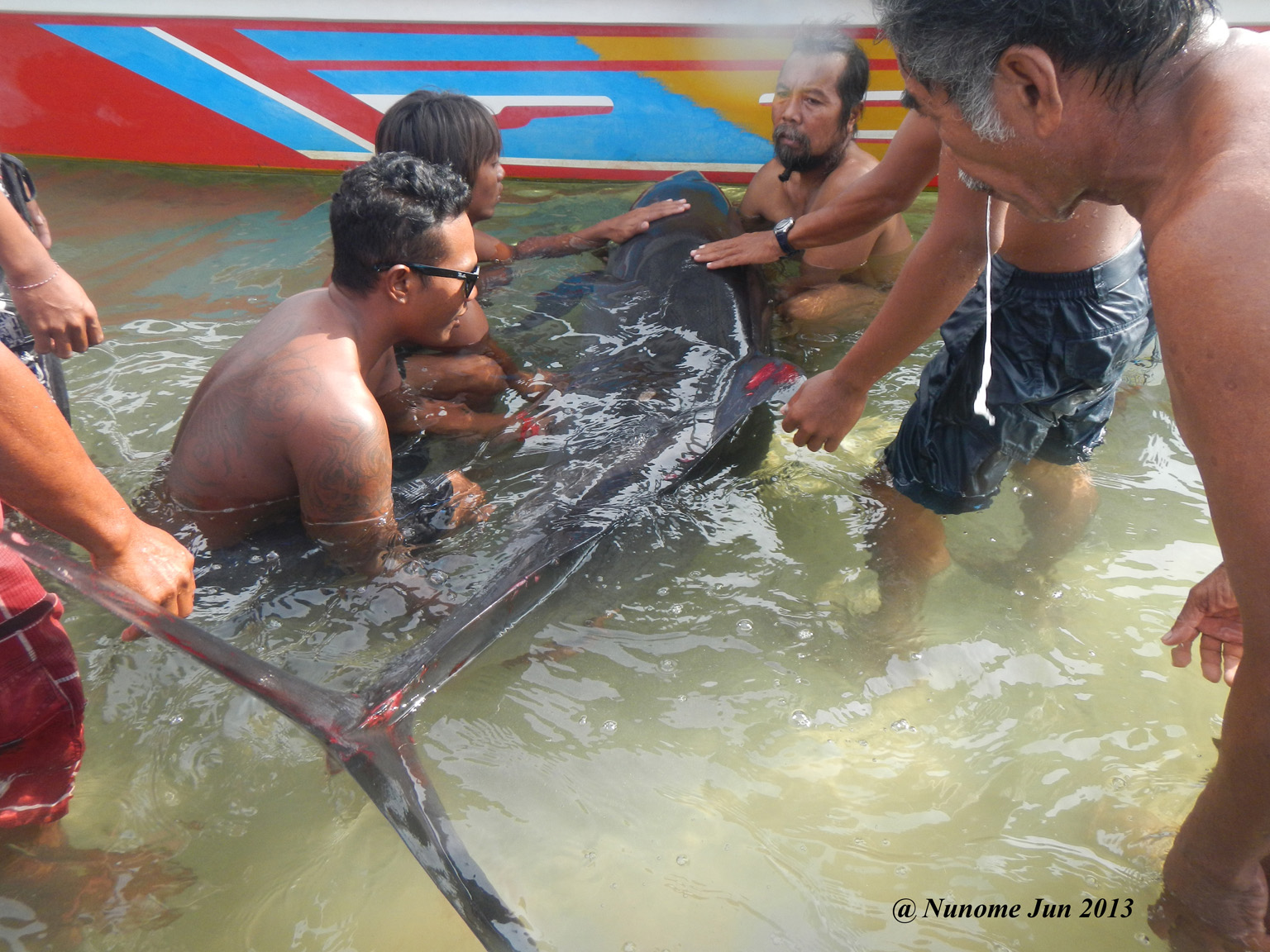
We had a stranding event of a (suspect) pygmy killer whale (Feresa attenuata ) dwarf sperm whale (Kogia sima) this morning in Sanur, Bali (19 Feb 2013). One animal, stranded twice. First at 7am, where the local surfers and beach boys herded the animal back to the deeper water. At 9am, the same animal returned to the same place. This time, the locals and the surfers loaded the poor thing into a jukung and went to deeper water to release it. May it roams safely out there at sea and will never strand again. Approximate body length: 2 m.

I learned of this news from Benjamin Kahn, who got the heads up from Femke JAAN (Thanks Ben and Femke for the heads up!). I arrived in Semawang Sanur around 11 am. Together with Pariama Hutasoit who arrived before me, we collected the above information. I obtained the pictures from a Japanese surfer girl (Nunome Jun-san) who took the photographs and helped the rescue. All photo credit is to Jun-san (Jun-san, arigatou zonjimasu!).

I'm concerned with the many wounds on its body. I’ve sent the pictures to a vet friend of mine for expert opinion. 

Dwarf sperm whale terdampar hidup di Sanur, Bali (19 Feb 2013)

This is the Indonesian version of a stranding event in Sanur (19 Feb 2013). Click here for the English version.


Penduduk lokal Semawang Sanur berusaha menyelamatkan si hewan


Seekor paus pembunuh kerdil (dugaannya adalah pygmy killer whale – Feresa attenuata) dwarf sperm whale (Kogia sima) terdampar pagi ini di Sanur, Bali. Dua kali terdampar: jam 7 pagi dan jam 9 pagi. Pada jam 7 pagi si binatang diselamatkan dengan cara menggiringnya kembali ke laut dalam dengan sekoci. Jam 9 pagi, si hewan balik lagi. Kali ini, beach boys dan surfer di Sanur mengangkat hewan tersebut ke dalam jukung dan melepaskannya ke laut lepas. Semoga dia selamat dan tidak terdampar lagi.  Panjang tubuh sekitar 2 m.
 
 Saya mengetahui berita ini dari Benjamin Kahn yang mendapat kabar dari Femke JAAN (Thanks Ben and Femke for the heads up!). Saya tiba di lokasi sekitar pukul 11 siang. Bersama dengan Pariama Hutasoit yang sudah terlebih dahulu tiba di tempat, kami memperoleh informasi di atas. Untuk foto, akhirnya saya dapat dari Miss Nunome Jun, surfer Jepang yang juga membantu rescue pagi hari ini. Semua sumber foto dari Jun-san (domo arigatou zonjimasu!).

Saya rada kuatir dengan luka-luka di sekujur tubuhnya. Saya sudah kirim foto2 ini ke rekan vet saya untuk pendapat ahlinya.